When should a chatbot hand over to a human on WhatsApp? Seven moments with examples
A person should take over when the customer asks for one, wants to change an existing order or booking, raises a refund or payment problem, is upset, or asks something the AI cannot answer from your business details. Let the AI handle routine questions like price and order status. Below: a table of seven handover moments and a sample Hinglish conversation.

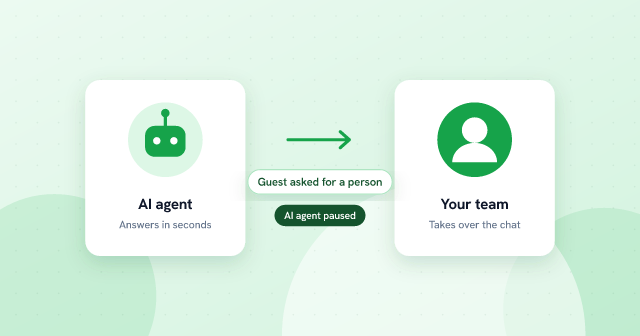
The short answer: hand over when money, changes, complaints or uncertainty come up
An AI agent is good at questions that have one correct answer written down somewhere: the room rate, the delivery area, the clinic timings, whether breakfast is included. It is a poor fit for anything that needs judgement, authority or care. That is where a person should take over.
In short, hand over when the customer asks for a human, wants to change something that already exists (an order, a booking), raises a refund or payment problem, sounds upset, or asks something your business details do not cover. For everything else, let the AI reply.
There are two ways to get this wrong. If you hand over too late, the AI guesses on something sensitive, such as promising a refund or changing an address on a shipped parcel. If you hand over too early, your team ends up answering every 'price kya hai?' message itself, at 11 PM, and the point of having an agent is lost. The goal is simple: the AI answers the routine questions, and a person handles the judgement calls.
Seven situations where a person should take over (with example messages)
This is guidance for you as the business owner, not a setting or an automatic trigger. Use it to decide who on your team picks up which kind of chat. The example messages are written the way customers actually type, with the meaning given in brackets.
| Situation | Example customer message | Why a person should handle it | Usual owner |
|---|---|---|---|
| Customer asks for a human | 'Kisi se baat karni hai.' (I want to talk to someone.) | The customer has already decided. Making them argue with an AI makes the mood worse. | Whoever is on duty |
| Change to an existing order or booking | 'Address change kar do, main naye flat mein shift ho gaya.' (Please change the address, I have moved to a new flat.) | Changes touch dispatch, room inventory or a payment already made. A wrong guess costs money. | Order desk or reservations |
| Refund, cancellation or payment dispute | 'Paisa kat gaya par booking confirm nahi hui.' (Money was deducted but the booking is not confirmed.) | Someone must check records and make a decision the AI should not make. | Owner or accounts |
| Payment verification | 'Payment kar diya, screenshot bhej raha hoon.' (I have paid, sending the screenshot.) | A person should confirm that the money has actually arrived before you act on it. | Accounts or front desk |
| Complaint or angry tone | 'Ye kya bakwas service hai, teen din se wait kar raha hoon.' (What rubbish service is this, I have been waiting three days.) | The customer needs a human apology and someone with authority to fix the problem. | Owner or manager |
| Question outside your FAQs, policies or catalogue | 'Can my father use a wheelchair on the ground floor?' (Your details do not say.) | If the answer is not in your business details, the AI would be guessing. | Whoever knows the answer |
| Custom or high-value request | 'Shaadi ke liye 20 rooms chahiye, teen din.' (We need 20 rooms for three days for a wedding.) | Group blocks and bulk orders need a custom quote and a conversation, not a standard reply. | Owner or sales |
Add one more category that does not fit neatly in a table: sensitive personal matters. If a clinic patient starts describing symptoms, or a customer shares something private, the chat should go to a person on your team. Whatever the customer is told in the meantime should only say that someone will get back to them, and should not respond to the substance.
What a clean handover looks like: a sample Hinglish conversation
The conversation below is a sample with a demo business, not a real customer. It shows the exact moment owners worry about: a customer moves from a routine question to one the AI should not handle.
Order #4821 kab aayega?
Aapka order #4821 dispatch ho chuka hai - expected delivery Thursday tak. Tracking: saliq.ai/t/4821
I need to change the delivery address
Koi baat nahi - address change ke liye main aapko team se connect kar raha hoon.
- Priya (Support) joined · agent paused
- The customer asks for order statusThis is a routine question. The agent answers it on its own, in Hinglish, because that is how the customer wrote.
- The customer asks to change the addressThis is a change to an existing order, the second row of the table above. The agent does not try to handle it.
- The agent hands the chat to a human and pauses itselfThe conversation goes to a teammate, and the agent stops replying, so only one voice answers the customer.
The pause matters. Without it, the customer could get two replies at once, one from the AI and one from your teammate, and the two might disagree. With the agent paused, there is one voice in the chat. Also notice that the reply stays in the language the customer used. SALIQ's Hinglish WhatsApp chatbot replies in English, Hindi or Hinglish, whichever the customer writes in, and your team can continue in the same language.
What the AI can keep handling, so your team is not flooded
Handover only works if it is rare enough to be done properly. If your team gets every chat, nobody has time to handle the refund or the complaint well. The agent answers from your rates, catalogue, FAQs and policies, so these routine questions should stay with it:
- Prices and rates ('Price kya hai?')
- Availability ('Kal room milega?')
- What is included in a room, package or product
- Order status
- Sending a booking link
If you run a hotel or homestay, our post on answering hotel guest questions on WhatsApp is the place to build those answers.
Here is the habit that keeps the load down. Every week, look at the questions that reached a person. If the same one keeps coming back, such as check-in time, parking or pet policy, the answer is missing from your business details. Add it there once, instead of handing that question to your team again and again.
How to set up your team for handovers, step by step
Everything in this list is something your business does, and none of it depends on a special setting.
- Decide who owns which situationTake the seven rows in the table and write a name or role next to each: front desk, owner, accounts. Keep it to one page that everyone on shift can read.
- Agree on the first message your team sendsWhen a person picks up, the customer should hear who you are and what happens next, with an honest time. For example: 'Namaste, main Riya hoon. Aapke address change ko main abhi check kar rahi hoon, 15 minute mein bata dungi.' (Hello, I am Riya. I am checking your address change and will update you in 15 minutes.) Do not promise a time you cannot keep.
- Make sure the person on duty sees chats on their phoneThe SALIQ Android app puts the shared inbox on your phone. Every conversation the agent is handling is there, and you can step in, reply and hand it back from anywhere.
- Reply in the customer's languageIf the customer wrote in Hinglish, answer in Hinglish. Switching to formal English in the middle of a chat feels like a different business has arrived.
- Hand the conversation back once the sensitive part is doneAfter the address is changed or the refund is settled, hand the chat back so the agent can handle the next routine question. Your team should not stay stuck answering price queries from a customer it helped an hour ago.
Handover edge cases: late nights, phone calls and replying late
After hours, be honest about when a person will reply. If a customer asks for a human at 11:30 PM and nobody is on shift, the handover message should say so: 'Hamari team subah 9 baje ke baad aapko message karegi.' (Our team will message you after 9 AM.) A customer who is told the real time knows what to expect; one who is promised 'jaldi' and then hears nothing is left waiting.
Phone calls follow the same idea. SALIQ voice agents answer calls on your business number in Hindi and English and log each call with its outcome, which can be a booking, a lead or a callback request, in the same inbox as your chats. A callback request is a handover too: someone on your team needs to own it and call back.
If a person replies the next day, WhatsApp's 24-hour window may apply (see WhatsApp's Business Messaging Policy, as of November 2026). Sending a message after that window works differently from replying inside it. Our post on messaging a customer after 24 hours on WhatsApp explains what to check before your team replies late.
Frequently asked questions
Can the customer ask for a person directly?
Yes, and you should treat that as a handover situation every time. A customer who writes 'kisi se baat karni hai' (I want to talk to someone) should reach a person, not be talked out of it.
Will the AI keep replying after my team steps in?
In the sample conversation, the agent pauses itself after it hands the chat to a teammate, so the customer does not get two replies at once. Once your team is done, you can hand the conversation back.
Can I take over a chat from my phone?
Yes, with the SALIQ Android app. Every conversation your AI agent is handling is on your phone, and you can step in, reply and hand it back from anywhere.
Should the AI handle refunds?
No. A person should decide refunds, cancellations and payment disputes, because they need checking records and a decision. Tell the customer that a teammate will look into it.
Does WhatsApp require businesses to offer a way to reach a person?
WhatsApp's Business Messaging Policy says, as of November 2026, in its section on the WhatsApp Business Platform: "You may use automation when responding during the 24-hour window, but must also have available prompt, clear, and direct escalation paths." The wording is about escalation paths in general, so check the full policy for what counts.
Sources
Keep reading
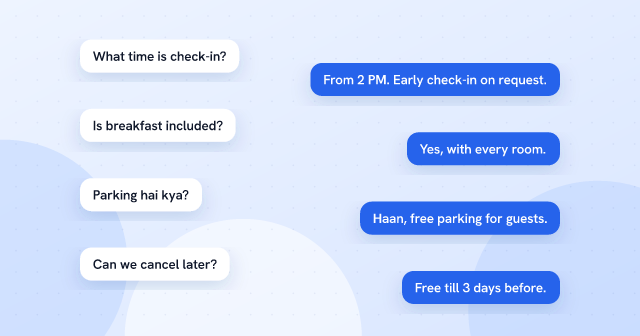 Hotels & bookings
Hotel WhatsApp replies to guest questions: 10 ready ones
Ten common hotel guest questions with a sample reply for each, Hinglish versions, app steps to save quick replies, and what still needs a person.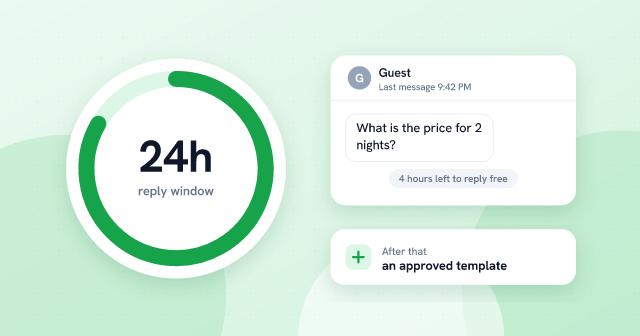 WhatsApp
How to message a customer after 24 hours on WhatsApp
Count the 24-hour WhatsApp window correctly, write a follow-up template Meta can approve, and know what a follow-up costs since 1 October 2026.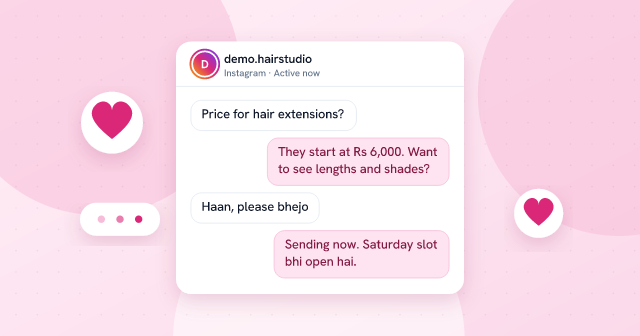 Instagram
How to auto reply to Instagram DMs and sound human
A practical guide to automatic Instagram DM replies that answer the actual question, work in Hinglish and know when to hand over to a person.Get started now. Live in minutes.
Put an AI agent on your WhatsApp, Instagram and website, and let your team take over any chat.